
Consultation Hotline
+1 (302) 618-8777
+1 (302) 618-8777
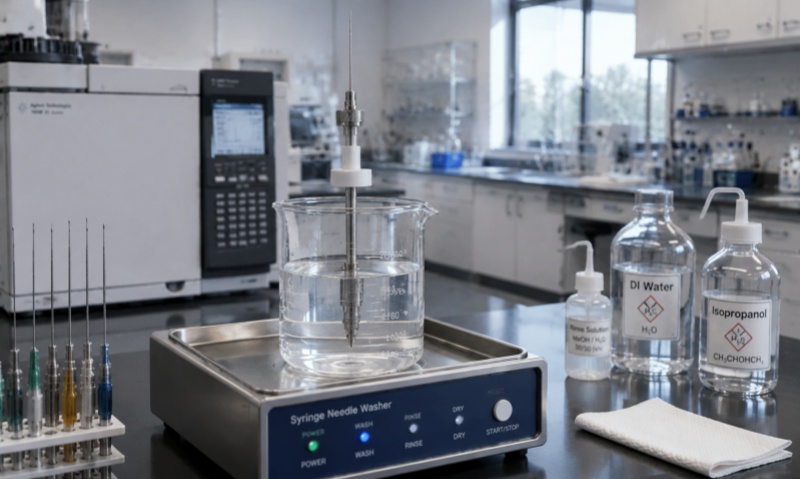
The autosampler injection needle is a critical component in High Performance Liquid Chromatography (HPLC) systems, responsible for aspirating and delivering precise sample volumes into the injection loop or valve. Because it repeatedly contacts complex biological or chemical samples, it is highly susceptible to contamination, blockage, and mechanical damage. Proper cleaning and careful handling are essential not only to maintain analytical accuracy but also to prevent needle bending, which is one of the most common mechanical failures in autosamplers.
During repeated injections, sample residues can accumulate inside and outside the needle. These residues may include proteins, salts, buffers, or hydrophobic compounds that adhere strongly to stainless steel surfaces. If not properly removed, they can lead to:
Carryover between injections
Reduced injection precision
Ghost peaks in chromatograms
Needle clogging or partial blockage
Therefore, routine cleaning of the injection needle is essential for maintaining system performance and reproducibility.
Internal cleaning is performed through the autosampler’s built-in wash system.
Procedure:
Flush the needle interior with high-strength organic solvent such as methanol or acetonitrile
Follow with deionized water if aqueous compatibility is required
Repeat wash cycles between injections or batches
Purpose:
Removes internal residues and prevents carryover inside the needle channel.
External contamination is often more severe due to sample contact during aspiration.
Procedure:
Immerse needle tip in strong wash solvent reservoir
Use multiple aspiration/dispense cycles
Increase wash time for high-protein or sticky samples
Recommended solvents:
Methanol or acetonitrile for general cleaning
50:50 water-organic mixture for polar residues
Mild acid or base solutions (if chemically compatible)
When routine washing is insufficient:
Use isopropanol (IPA) for hydrophobic contaminants
Apply extended soaking cycles
Run multiple blank injections after cleaning
For biological samples:
Use diluted surfactant solutions (e.g., 0.1% SDS) followed by thorough rinsing
If the needle is partially blocked:
Remove needle assembly (if serviceable design allows)
Place in ultrasonic bath with suitable solvent
Clean for 10–20 minutes
Dry with nitrogen or clean air before reinstallation
Needle bending is a mechanical failure that can lead to severe autosampler damage and inconsistent injection performance. The most common causes include:
If sample vials are not correctly positioned in the rack:
The needle may strike the vial wall or cap
Repeated collisions gradually deform the needle
Symptom: Sudden injection failure or abnormal autosampler noise.
Autosampler parameters determine how deep the needle penetrates into the vial.
Excessive depth → needle hits vial bottom
Insufficient calibration → uneven movement and side impact
Hard or misaligned septa increase resistance during penetration.
Thick septa require higher force
Reused septa may not reseal properly
This increases lateral stress on the needle.
Over time, autosampler mechanical components may shift.
Worn guide rails
Loose arm assembly
Incorrect calibration of X-Y-Z positioning
These issues cause the needle to deviate from its vertical path.
Common user-related mistakes include:
Using incompatible vial types
Incorrect installation of sample trays
Overfilling vials causing splash contamination and resistance
Regularly calibrate autosampler positioning system
Verify needle alignment in all axes
Perform periodic maintenance checks
Use manufacturer-recommended vials
Avoid deformed or reused septa
Ensure uniform vial height and geometry
Adjust penetration depth according to vial type
Avoid excessive insertion into narrow or low-volume vials
Validate settings during method development
Check needle straightness visually under light
Inspect autosampler arm for looseness
Replace worn mechanical parts promptly
Avoid high-speed aggressive injection cycles when unnecessary
Use pre-defined safe injection methods for fragile samples
Ensure correct sample tray installation before running sequences
To ensure long-term stability of the injection system:
Perform daily needle wash cycles after runs
Use appropriate solvent strength based on sample type
Inspect needle weekly for early signs of wear
Replace needle if deformation or blockage occurs
Maintain clean and properly aligned vial racks
The HPLC injection needle is a precision component that requires both effective cleaning and careful mechanical handling. Contamination is mainly controlled through proper internal and external wash procedures, while needle bending is typically caused by misalignment, incorrect depth settings, vial issues, or mechanical wear.
By combining routine cleaning, correct operational parameters, and regular system calibration, laboratories can significantly extend needle lifespan, reduce carryover risk, and ensure consistent and accurate chromatographic performance.