Case Study: LabRivive’s Repair Service for PCR Instruments in a U.S.-Based Biotechnology Company
1. Background
LabRivive, a U.S.-headquartered professional laboratory instrument maintenance and repair company, specializes in providing high-quality, cost-effective repair solutions for a wide range of life science instruments, with a focus on PCR (Polymerase Chain Reaction) systems, microplate readers, and nucleic acid analysis equipment. With a team of certified senior engineers proficient in chip-level repair and years of experience in maintaining various PCR instrument brands (including ABI, Bio-Rad, and Thermo Fisher), LabRivive has established a solid reputation in the U.S. biotechnology, pharmaceutical, and academic research industries for its efficient response, professional technical capabilities, and reliable post-repair support. PCR instruments are core tools in molecular biology laboratories, widely used in gene amplification, pathogen detection, genetic variation analysis, and diagnostic reagent development, relying on precise temperature control and stable thermal cycling to ensure accurate and reproducible experimental results.
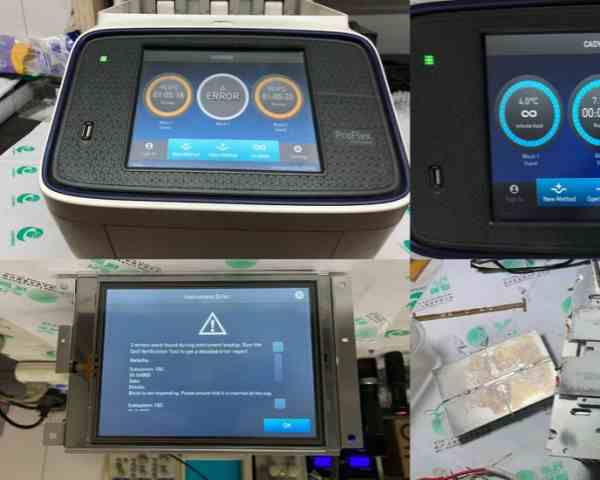
The client in this case is a medium-sized biotechnology company located in California, USA, focusing on molecular diagnostics and pathogen detection reagent development. The company’s three PCR instruments (two conventional PCR systems and one gradient PCR system) had been in continuous operation for 4-5 years and suddenly malfunctioned simultaneously, seriously disrupting its routine experimental work and reagent development progress. The instruments exhibited multiple abnormal symptoms: unstable thermal cycling (temperature fluctuations exceeding the standard range), failed lid heating (leading to sample evaporation and inaccurate results), unresponsive control panels, frequent power interruptions, and distorted amplification curves. Given the critical role of PCR instruments in the company’s daily operations and the high cost of downtime, the client urgently needed professional repair services to restore all malfunctioning instruments to normal operation within the shortest possible time. After comparing multiple repair service providers, the client chose LabRivive due to its professional reputation in PCR instrument repair, rich experience in handling common and complex PCR malfunctions, and commitment to timely on-site service within 24 hours.
2. Repair Process
LabRivive adopted a systematic and standardized repair process to address the malfunctions of the PCR instruments, combining professional diagnostic technology with PCR system maintenance specifications, ensuring accuracy and efficiency at every step, in line with industry-standard maintenance protocols and ISO/IEC 17025 calibration requirements.
First, after receiving the client’s service request, LabRivive’s customer service team quickly collected detailed information about each PCR instrument’s malfunction, including error codes, operation records, recent experimental results (such as distorted amplification curves and failed reactions), and power supply conditions. A team of two certified senior engineers with more than 7 years of experience in PCR instrument repair was assigned to the case, and an on-site service appointment was scheduled within 24 hours, fully meeting the client’s urgent needs for restoring experimental operations.
Second, on-site diagnosis was carried out comprehensively for each malfunctioning PCR instrument. The engineers first conducted a visual inspection of each instrument, checking the thermal block, lid heater, power module, control panel, internal circuit boards, and thermal sensors for physical damage, contamination, loose connections, or component aging. Using professional diagnostic tools including temperature calibrators, multimeters, and thermal cycling testers, the engineers performed a series of systematic tests, including temperature accuracy verification, lid heating performance testing, power supply stability analysis, control panel debugging, and thermal sensor calibration. The diagnosis results showed that the main malfunctions were consistent across the three instruments with minor differences: the thermal sensors were aged, leading to unstable temperature control; the lid heater’s heating element was burned out, causing failed lid heating; the power module’s capacitors were aged, resulting in power interruptions; and the control panel’s circuit board had loose connections, leading to unresponsive operation.
Third, targeted repair measures were implemented for each instrument. The engineers first replaced the aged thermal sensors and burned-out lid heater elements with genuine brand-compatible components, ensuring precise temperature control (accuracy ≤±0.3℃) and effective lid heating (temperature stable at 105℃). Next, the aged capacitors in the power module were replaced to eliminate power interruptions and ensure stable power output. The control panel’s circuit board was reconnected and secured, and the instrument’s firmware was updated to resolve unresponsive operation issues. Additionally, the thermal blocks were thoroughly cleaned to remove sample residues and prevent cross-contamination, and the thermal cycling parameters were recalibrated to match the client’s experimental requirements. Throughout the repair process, the engineers maintained close communication with the client’s laboratory staff, explaining the malfunction causes and repair progress in detail, and providing preliminary suggestions for daily maintenance.
3. Repair Results and Verification
The entire repair process for all three PCR instruments was completed within 48 hours from the initial service request, ahead of the scheduled 72 hours, minimizing the impact on the client’s experimental work and reagent development progress, and reducing downtime losses. After the repair, a series of strict verification tests were conducted for each instrument, in line with international PCR instrument performance standards and ISO/IEC 17025 calibration requirements.
The verification results showed that all three PCR instruments could operate stably without any error prompts. The thermal cycling was stable, with temperature fluctuations within the standard range; the lid heating function was fully restored, effectively preventing sample evaporation; the control panel responded normally, and the power supply was stable without interruptions. The instruments’ amplification performance was verified using standard DNA samples, and the results showed clear, symmetrical amplification curves, consistent Ct values (coefficient of variation ≤2%), and high reproducibility, fully meeting the client’s experimental requirements. The client’s laboratory staff also conducted a series of routine experiments, including pathogen detection and gene amplification, and the experimental results were consistent with the expected standards, confirming that all malfunctioning PCR instruments had been fully restored to normal operation.
In addition, LabRivive provided the client with a 6-month repair warranty for all repaired PCR instruments, including free on-site maintenance and component replacement (if any quality issues arise from the repair), as well as professional technical support and daily maintenance guidance. The guidance included suggestions for regular cleaning of the thermal block, calibration of temperature parameters, replacement of worn components, and proper storage of the instruments (temperature 18-25℃, humidity 40%-60%) to avoid contamination and component aging. The client highly recognized LabRivive’s efficient service, professional technical capabilities, and reliable repair quality, noting that LabRivive’s repair cost was significantly lower than the original manufacturer’s service.
4. Conclusion
This case demonstrates LabRivive’s professional strength and customer-centric service concept in the repair of high-precision life science instruments such as PCR systems. By adopting a systematic diagnosis, targeted repair strategy, and combining professional technical capabilities with rich PCR instrument maintenance experience, LabRivive successfully resolved the instruments’ complex malfunctions (including temperature control, power supply, and control panel issues) in a short period of time, restored their performance to the official standard range, and minimized the impact on the client’s research and production work. Compared with the original manufacturer’s repair service, LabRivive’s service offers higher efficiency, more competitive pricing, and more flexible on-site support, addressing the industry’s core pain points of long repair cycles and high costs.
For laboratories relying on PCR instruments, timely and professional repair services are crucial to ensuring the smooth progress of research and production, as well as the accuracy and reliability of experimental results. LabRivive’s rich experience in PCR instrument repair, certified professional engineers, and efficient service process can provide reliable technical support for such laboratories, helping them reduce operational costs, avoid experimental errors caused by instrument malfunctions, and improve work efficiency. This case also provides a valuable reference for the maintenance and repair of similar PCR instruments in the industry, especially for resolving combined faults across multiple instruments.