Imported nitrogen generators are high-precision gas supply equipment widely used in modern laboratory analytical testing, chromatographic analysis, material synthesis, and precision instrument supporting work. Compared with ordinary domestic equipment, imported nitrogen generators feature high gas purity, stable pressure output, low failure rate and intelligent control systems, which can continuously provide high-purity nitrogen free of oxygen, moisture and particulate impurities for laboratory precision experiments. To maintain long-term stable operation, avoid gas purity deviation, pressure fluctuation and hidden safety hazards caused by abnormal equipment status, standardized regular self-inspection is essential. Scientific and systematic self-inspection can effectively eliminate latent faults, ensure consistent gas supply quality, extend equipment service life, and meet the strict gas supply requirements of high-precision laboratory instruments. This article systematically elaborates the complete set of standard self-inspection methods for imported laboratory nitrogen generators, covering pre-startup static inspection, power-on automatic self-test, operating dynamic inspection, air tightness detection and shutdown reset inspection, providing standardized technical guidance for laboratory equipment operation and maintenance.
Pre-startup static self-inspection is the basic link to eliminate potential faults and must be implemented strictly before each equipment startup. Different from ordinary laboratory equipment, imported nitrogen generators have higher requirements for installation environment and pipeline matching, so static inspection focuses on environment, circuit and gas circuit status. First, inspect the operating environment of the equipment. The generator should be placed in a dry, ventilated and dust-free laboratory area, avoiding direct sunlight, high-temperature heat sources and corrosive gas pollution. The ambient temperature should be controlled between 18℃ and 28℃, and excessive humidity and temperature difference are prohibited to prevent internal circuit condensation and molecular sieve performance degradation. Second, complete circuit safety inspection, check whether the power cord is intact and free of aging, breakage and virtual connection, confirm that the power supply voltage matches the equipment rated parameters, and the grounding device is reliable to avoid static accumulation and circuit failure. Third, inspect the air intake pipeline and filter components, check whether the external air source pipeline is connected firmly, whether the filter element is blocked or expired, and ensure no foreign matter or dust enters the equipment interior. All pipeline interfaces shall be checked for looseness to lay a safe foundation for subsequent power-on operation.
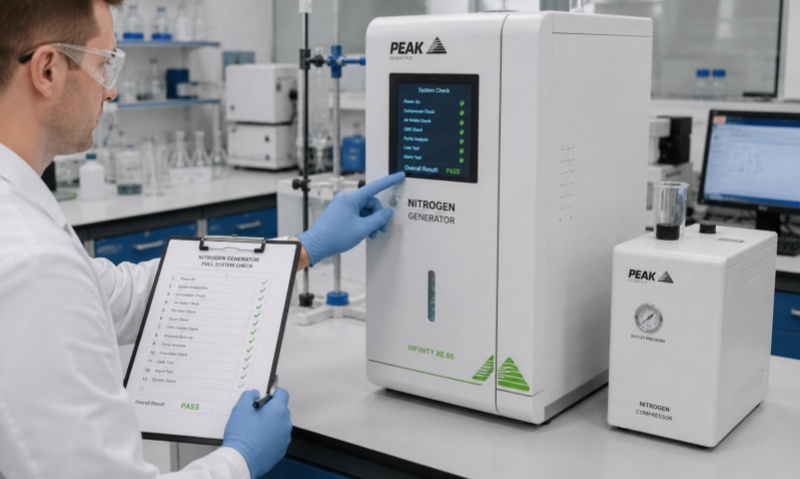
Power-on automatic self-test is the core intelligent detection procedure of imported nitrogen generators. Most imported models are equipped with built-in intelligent self-diagnosis programs, which can automatically detect internal circuit modules, sensor status, pressure system and control programs after power-on. After confirming that the static inspection is qualified, turn on the equipment power switch, and the system will automatically start the self-test program within 30 seconds. During the self-test period, observe the display screen data and indicator status in real time, check whether the system initialization is normal, whether the pressure sensor, temperature sensor and flow sensor have data deviation or alarm codes, and confirm that no fault prompts such as circuit abnormality and module failure appear. The self-test process usually lasts 3 to 5 minutes. After the system displays that the self-test is passed, it can enter the standby state. If abnormal codes appear, the operation must be stopped immediately, and the fault shall be eliminated according to the official operation manual of the imported equipment. It is forbidden to force startup with faults to avoid damaging the intelligent control module and precision detection components.
Dynamic self-inspection during operation is a key measure to ensure stable gas supply quality, focusing on real-time monitoring of pressure, flow rate and nitrogen purity parameters. After the equipment enters the normal operating state, continuous dynamic monitoring shall be carried out. First, inspect the intake and output pressure stability. The standard intake pressure of conventional imported nitrogen generators is maintained at 0.6 to 0.8 MPa, and the output nitrogen pressure is stable within the experimental required range. Observe the pressure gauge and digital display data for a continuous 10 minutes to confirm no sudden pressure rise, drop or floating fluctuation. Second, detect the gas flow stability, check whether the outlet flow is uniform and continuous, no intermittent gas supply and flow jitter, to ensure stable gas supply for supporting instruments. Third, conduct regular purity self-inspection. Rely on the built-in oxygen content and humidity detection module of imported equipment, real-time monitor nitrogen purity, oxygen residue and water content data. Normally, the nitrogen purity should reach more than 99.999%, and excessive oxygen and moisture content indicate abnormal failure of internal molecular sieve or purification components, which requires timely maintenance and replacement.
Air tightness self-inspection is a special and essential inspection item for nitrogen generators, which can effectively prevent gas leakage and system pressure loss. After the equipment operates stably, close the terminal gas outlet valve to make the equipment in a closed pressure holding state, record the initial pressure data, and keep the pressure holding state for 15 to 20 minutes. Observe the pressure change of the system, if the pressure drop is within the allowable range specified by the equipment, the air tightness is qualified; if the pressure drops rapidly, it indicates pipeline leakage or seal failure. Use soap solution to detect each pipeline interface, valve body and seal connection position, find out the leakage point accurately, fasten the loose interface or replace the aging sealing ring in time. Regular air tightness self-inspection can avoid insufficient nitrogen output pressure, reduced gas production efficiency and waste of gas resources caused by leakage, and eliminate the safety risk of nitrogen accumulation in the laboratory.
Shutdown reset and daily summary self-inspection are important links to ensure long-term stable operation of equipment. After the daily experiment is completed, follow the standard shutdown procedure to close the equipment, cut off the gas source first and then the power supply, and avoid direct power-off shutdown. After shutdown, check the residual pressure of the equipment system, confirm that the internal pressure is released normally, and record the daily operation data, including startup self-test status, operating pressure, flow rate and purity parameters. Regularly sort out the inspection records, compare the historical data changes, and judge the aging state of internal consumables such as filter elements and molecular sieves. For long-term unused equipment, conduct a full-item self-inspection again before restarting to ensure that all performance indexes meet the operating standards.
In conclusion, the self-inspection work of imported laboratory nitrogen generators runs through the whole process of before startup, during operation and after shutdown. Comprehensive and standardized self-inspection can effectively detect and eliminate latent faults such as poor air tightness, abnormal pressure, reduced purity and sensor failure. Laboratory operators should strictly implement self-inspection specifications, form standardized operation and maintenance habits, ensure that the equipment always operates in a stable and qualified state, provide high-purity and stable nitrogen support for laboratory precision experiments, and reduce equipment maintenance costs and experimental data errors caused by non-standard operation.