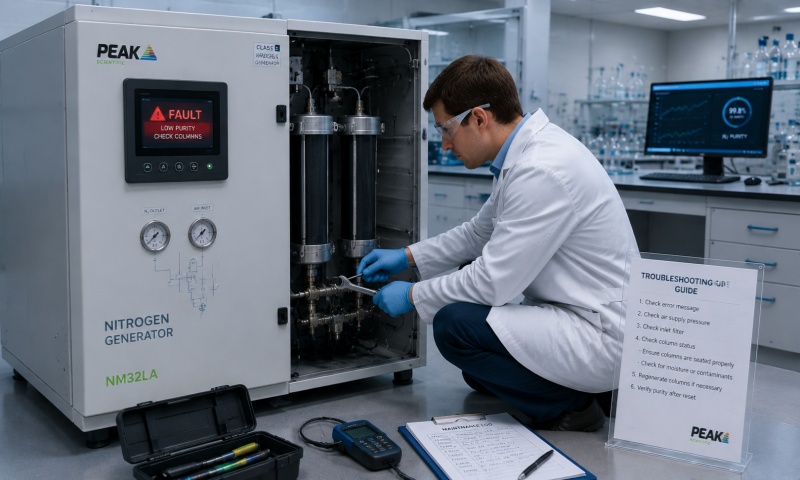
Imported nitrogen generators are critical high-precision gas supply equipment in modern laboratories, widely matched with gas chromatography, mass spectrometry, elemental analysis and other precision instruments. Different from ordinary domestic equipment, imported nitrogen generators adopt advanced pressure swing adsorption, membrane separation or purification technology, featuring high nitrogen purity, stable output pressure, low noise and intelligent control. Its operating stability directly affects the accuracy of experimental data and the service life of supporting analytical instruments. Due to the high precision and strict matching requirements of imported equipment, irregular maintenance will easily cause molecular sieve failure, pipeline blockage, pressure instability and decreased gas purity, leading to frequent instrument faults and increased laboratory operating costs. Based on the practical operation experience of imported laboratory gas supply equipment, this paper summarizes the core maintenance secrets of nitrogen generators, covering daily maintenance, regular consumable replacement, system parameter maintenance, air tightness protection and seasonal maintenance, so as to provide standardized technical guidance for laboratory equipment management.
Timely replacement and maintenance of consumable parts is the key secret to maintain stable gas supply quality. The core consumables of imported nitrogen generators mainly include air filter elements, activated carbon filters, precision filters and internal drying agents, which are the first barrier to ensure equipment purification capacity. Most laboratory operators ignore the regular replacement cycle of consumables, resulting in gradual blockage and failure of filter components. Blocked filter elements will increase air intake resistance, reduce gas production efficiency, and cause impurities and moisture to enter the purification system, contaminating high-precision molecular sieves. Under conventional laboratory working conditions, the primary air filter element needs to be replaced every 1 to 2 months, and the activated carbon and precision filter elements should be updated every 3 to 6 months. For laboratories with poor raw air quality, the replacement cycle should be appropriately shortened. After replacing the consumables, it is necessary to perform idle running and purging to remove residual dust and impurities in the pipeline, ensuring the cleanliness of the gas circuit system.
System pressure and gas circuit maintenance is an essential link to avoid equipment latent faults. Stable pressure system operation determines the continuity and stability of nitrogen output. In daily maintenance, operators should regularly check the inlet pressure, output pressure and tank pressure of the equipment, and record the data changes. The normal inlet pressure of imported nitrogen generators is stably maintained at 0.6 to 0.8 MPa, and the output pressure has no obvious fluctuation. If pressure drift or sudden pressure drop occurs, it is necessary to check whether the pipeline is blocked or the pressure regulating valve is abnormal. Meanwhile, regular pipeline purging maintenance should be carried out. Long-term operation will produce tiny impurity sediments in the gas circuit, which will affect the gas flow and purity. Regular circulating purging can effectively clean the pipeline sediments and keep the gas circuit unobstructed. In addition, it is necessary to avoid long-term no-load standby of the equipment, so as to prevent static precipitation of internal moisture and impurities, which will cause local blockage of the purification system.
Air tightness detection and sealing maintenance is a unique maintenance requirement for imported nitrogen equipment. The precision sealing performance of imported generators is far higher than that of ordinary equipment, and slight air leakage will lead to reduced nitrogen purity, unstable pressure and increased equipment operating load. It is necessary to carry out a complete air tightness inspection every month. Close the terminal gas outlet to keep the equipment in pressure holding state, record the initial pressure value, and observe the pressure change within 20 minutes. If the pressure drop exceeds the standard range, use soapy water to detect all interfaces, valve bodies and sealing parts. For aging and deformed sealing rings and gaskets, replace them with original imported accessories in time to ensure the sealing accuracy of the equipment. Regular air tightness maintenance can not only maintain stable equipment performance, but also effectively save gas consumption and reduce laboratory operating costs.
Seasonal maintenance and long-term shutdown protection are important secrets to extend equipment service life. In high-temperature and humid summer, the air humidity is high, which easily causes moisture accumulation inside the equipment. It is necessary to strengthen ventilation and dehumidification, appropriately increase the frequency of equipment purging, and check the drying state of the drying system. In low-temperature winter, avoid equipment working in ultra-low temperature environment to prevent pipeline hardening and sensor detection deviation. If the equipment is shut down for more than one week for a long time, it is necessary to completely release the residual pressure in the system, clean the internal pipeline, and cover the equipment with dust-proof cover. Before restarting after long-term shutdown, perform full-item inspection and idle running debugging to ensure that all performance indicators return to normal.
In conclusion, the maintenance of imported laboratory nitrogen generators is a systematic work combining daily protection, regular maintenance and seasonal debugging. Scientific maintenance can effectively maintain high nitrogen purity and stable pressure output, avoid common faults such as blockage, air leakage and performance attenuation, and greatly extend the service life of precision equipment. Laboratory operators should establish standardized maintenance files, strictly implement maintenance cycles and operational specifications, eliminate faults in advance, and provide long-term stable and high-quality nitrogen supply guarantee for laboratory precision analytical experiments.