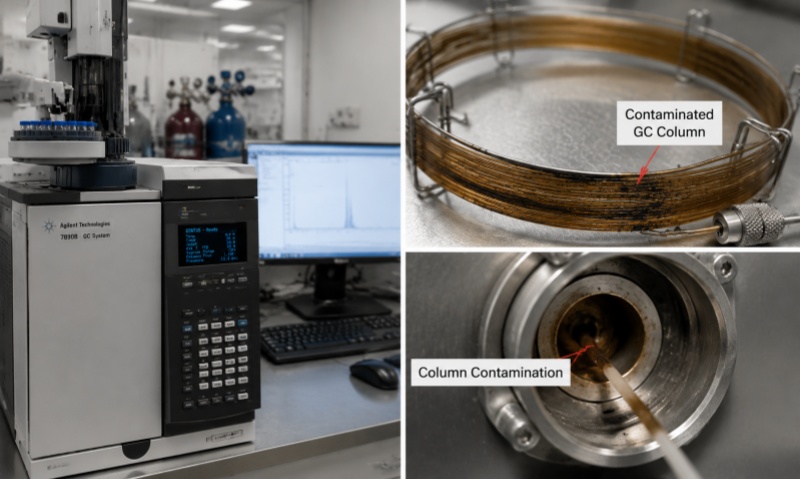
Chromatographic columns are the core separation components of high-performance liquid chromatography and gas chromatography systems, and their internal packing integrity and surface cleanliness directly determine the separation efficiency, peak shape symmetry, and quantitative accuracy of chromatographic analysis. In long-term laboratory testing operations, column contamination is one of the most common and unavoidable latent faults. Residual sample matrix, macromolecular impurities, insoluble sediments, and mobile phase pollutants will continuously accumulate on the column inlet and filler surface. Mild contamination will cause peak tailing, baseline drift, increased noise, and reduced separation resolution, while severe contamination will lead to column blockage, abnormal system pressure, ghost peaks, and irreversible damage to the stationary phase, resulting in shortened column service life and invalid experimental data. To ensure stable instrument operation and accurate test results, this article systematically analyzes the main types and causes of chromatographic column contamination, and summarizes standardized grading treatment methods and long-term anti-contamination maintenance strategies.
The contamination of chromatographic columns can be divided into three categories according to pollutant properties: particulate contamination, organic macromolecular contamination, and irreversible adsorption contamination, each with distinct failure characteristics. Particulate contamination mainly comes from unfiltered sample solution, undissolved impurities in mobile phase, and pipeline aging debris. These tiny solid particles deposit at the column inlet, blocking the flow channel of the filler, causing rapid increase of system back pressure and irregular peak shape distortion. Organic macromolecular contamination is primarily derived from biological samples, crude extract samples, and high-boiling residual substances. Such substances cannot be eluted by conventional mobile phases and will adhere to the stationary phase surface for a long time, covering active sites and resulting in continuous baseline rise and periodic impurity peaks. Irreversible adsorption contamination is caused by strong polar impurities and metal ion residues, which will produce permanent adsorption on the column filler, seriously damaging the separation performance and leading to irreversible column performance degradation.
Timely and accurate pollution diagnosis is the premise of effective treatment. Laboratory operators can quickly judge the contamination degree through instrument operating parameters and chromatographic spectral changes. The typical characteristics of mild contamination include slight baseline fluctuation, minor peak tailing, and slow pressure rise during operation, which usually occurs after routine analysis of complex samples. Moderate contamination is manifested as obvious ghost peaks, decreased separation degree of target compounds, and continuous floating baseline, which will directly affect the accuracy of qualitative and quantitative analysis. Severe contamination features sharp over-limit back pressure, serious column blockage, chaotic baseline noise, and complete failure of peak separation, requiring immediate stop of analysis and thorough cleaning and maintenance. Regular comparison of daily spectral data and pressure changes can effectively realize early warning of column contamination.
For mild and moderately contaminated chromatographic columns, gradient elution and solvent flushing are the most safe and effective conventional treatment methods, which are suitable for most reversed-phase and normal-phase chromatographic columns. For reversed-phase columns commonly used in liquid chromatography, low-concentration organic solvent mixed solution is adopted for gradual flushing to avoid sudden solvent polarity changes causing filler collapse. Firstly, stop the sample injection and replace the contaminated mobile phase with pure water to flush the column for 30 to 60 minutes to remove water-soluble residual impurities. Then, gradiently switch to methanol or acetonitrile aqueous solution with increasing organic ratio to elute weakly adsorbed organic pollutants. Finally, high-purity organic solvent is used for deep cleaning to remove medium-polarity adsorbed substances. For columns polluted by strong polar impurities, appropriate weak acid or weak neutral cleaning solution can be selected for circulating elution according to column resistance parameters to thoroughly strip residual pollutants.
For severely blocked and heavily contaminated chromatographic columns, targeted dismantling and local renovation treatment is required. Most severe contamination accumulates at the column inlet rather than the whole column. Operators can cut off 1 to 2 centimeters of the filler at the column inlet under dust-free and anhydrous conditions to remove the most severely polluted and invalid filler, then fill the inlet with homogeneous new stationary phase and reinstall the column head. After renovation, low-flow solvent flushing must be carried out for a long time to stabilize the column balance. It is worth noting that this method is only applicable to conventional packed columns, and precision capillary chromatographic columns are prohibited from arbitrary cutting and dismantling to avoid structural damage. After all cleaning and renovation operations, column performance verification must be completed, including pressure stability test, peak shape detection, and resolution calibration, and the column can only be reused after reaching the standard.
Long-term standardized operation and preventive maintenance are the fundamental measures to avoid chromatographic column contamination. First, strictly standardize sample pretreatment, filter all sample solutions through microporous filter membranes before injection, remove insoluble particles and macromolecular impurities, and avoid direct injection of crude extract and turbid samples. Second, ensure the purity of mobile phase, use chromatographic-grade reagents and ultrapure water, and conduct ultrasonic degassing and filtration treatment before use to prevent mobile phase impurities from polluting the column. Third, establish regular column maintenance habits, replace the protective column and filter core regularly to intercept pollutants, and perform comprehensive solvent cleaning and column balancing after batch sample analysis. In addition, avoid long-term placement of columns in residual polluted solvent, and store them with protective organic solvent sealing.
In conclusion, chromatographic column contamination is a progressive cumulative fault formed by non-standard sample pretreatment, incomplete mobile phase purification and insufficient daily maintenance. Different degrees of contamination correspond to targeted cleaning and repair schemes. Mild pollution can be eliminated by gradient solvent flushing, moderate pollution needs targeted elution and deep cleaning, and severe pollution requires local renovation and performance calibration. Laboratory staff should adhere to prevention first and treatment second, standardize the whole process of sample preparation, instrument operation and equipment maintenance, effectively reduce the column contamination rate, maintain stable chromatographic separation performance, ensure the authenticity and accuracy of experimental test data, and extend the service life of high-cost chromatographic columns.