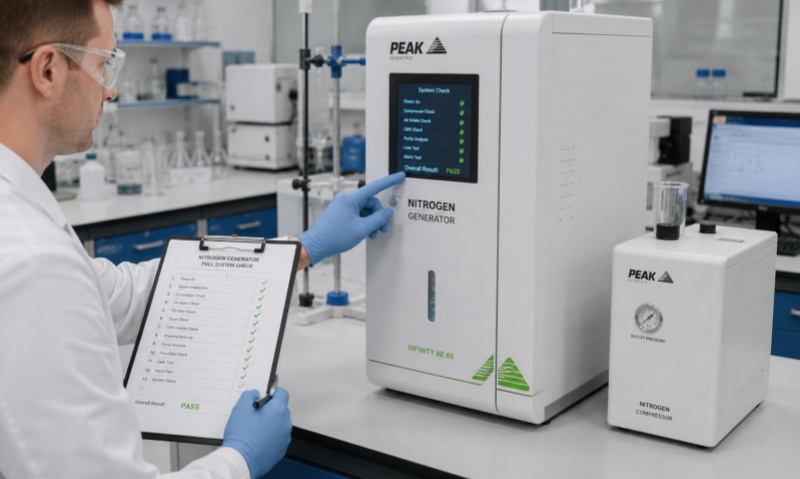
Laboratory nitrogen generators are indispensable core supporting equipment for gas chromatography, mass spectrometry, trace analysis and other precision experimental scenarios. They provide stable, high-purity nitrogen carrier gas and auxiliary gas, directly affecting experimental accuracy, instrument stability and laboratory operational safety. Long-term continuous operation, environmental changes and aging of internal components may cause problems such as unstable air pressure, decreased nitrogen purity and pipeline leakage. Regular standardized self-inspection is essential to eliminate hidden risks, ensure consistent gas supply quality, extend equipment service life and avoid experimental data deviation caused by equipment failure. This article systematically introduces the full-process self-inspection specifications and operational methods for laboratory nitrogen generators, providing practical technical guidance for daily laboratory operation and maintenance.
Pre-startup static self-inspection is the primary link to eliminate potential faults, focusing on environmental inspection, circuit and gas circuit safety check and accessory status confirmation. First, inspect the operating environment of the equipment. The nitrogen generator should be placed in a dry, ventilated and dust-free area with ambient temperature controlled at 15-30°C, avoiding direct sunlight and high-temperature heat sources. Ensure the equipment placement is stable and the heat dissipation channels are unobstructed to prevent overheating operation. Second, complete circuit safety inspection, check whether the power cord is intact and firmly connected, confirm the power voltage matches the equipment rated parameters, and verify that the power switch and protective devices work normally without aging, short circuit or poor contact.
In terms of gas circuit and accessory inspection, fully check the intake filter, drying tube, adsorption tower and connecting pipelines. Confirm that the filter element is not blocked or overdue for replacement, and the desiccant inside the drying tube is in normal state without large-scale discoloration and failure. Inspect all gas pipe joints, valves and sealing parts for looseness, aging or damage. Meanwhile, check the internal molecular sieve and buffer tank status to ensure no foreign matter accumulation. For equipment that has been shut down for a long time, manually drain the residual water in the pipeline and tank to prevent condensed water from affecting gas purity and causing internal component corrosion.
Dynamic operation self-inspection after startup focuses on pressure stability, operating status and real-time operational parameters. After turning on the equipment power, start the self-check program and observe the indicator lights and system display interface to confirm no fault codes or alarm prompts. Let the equipment run idle for 15 to 30 minutes to complete preheating and system stabilization. During operation, monitor the intake pressure, output nitrogen pressure and internal tank pressure in real time. The pressure values should rise steadily and maintain within the standard range without sudden fluctuation or pressure drop. Abnormal pressure drop usually indicates pipeline leakage or valve failure, while slow pressure rise may be caused by filter blockage or insufficient air intake.
Gas tightness inspection is a key self-inspection item to ensure stable gas supply. Adopt the standard pressure holding test method for full pipeline sealing detection. Adjust the equipment to the rated working pressure, close the outlet valve to seal the gas circuit, and keep pressure holding for 10 to 15 minutes. Observe the pressure gauge changes; if the pressure drop is within the allowable standard range, the gas tightness is qualified. For tiny leakage points, apply special foam detection liquid at pipe joints and valves to check for bubble generation. Timely fasten joints or replace aging sealing accessories once leakage is found to avoid gas waste and unstable gas supply.
Nitrogen purity and performance calibration self-inspection determines whether the equipment meets experimental usage standards. Use a professional nitrogen purity analyzer to sample and detect the output gas, focusing on nitrogen concentration, residual oxygen content and moisture content. Conventional laboratory analytical experiments require nitrogen purity above 99.999%, with ultra-low residual oxygen and moisture to prevent interference with precision detection. If the purity fails to reach the standard or fluctuates abnormally, check whether the molecular sieve is saturated and invalid, whether the drying system fails, or whether the intake air quality is substandard. In addition, inspect the noise and vibration of the equipment during operation; uniform and stable operation without abnormal noise and severe vibration indicates normal internal compressor and adsorption system operation.
Daily regular self-inspection and fault early warning management are crucial for long-term stable operation of the equipment. Laboratory operators shall establish a complete self-inspection ledger, record daily operating pressure, purity data, operating status and maintenance records. Conduct a comprehensive detailed inspection every month and a deep system maintenance and calibration every quarter. For common abnormal phenomena such as slow pressure buildup, reduced gas production, purity decline and frequent alarms, timely troubleshoot and solve problems to avoid minor faults evolving into major equipment failures.
In conclusion, the scientific self-inspection of laboratory nitrogen generators covers static pre-inspection, dynamic operation monitoring, gas tightness detection, purity calibration and daily normalized management. Standardizing the full-process self-inspection operation can effectively ensure the stable and high-purity output of nitrogen, guarantee the accuracy and repeatability of laboratory precision experiments, reduce equipment failure rate and maintenance cost, and provide reliable safety and quality guarantee for daily laboratory analytical testing and scientific research work.