
Consultation Hotline
+1 (302) 618-8777
+1 (302) 618-8777
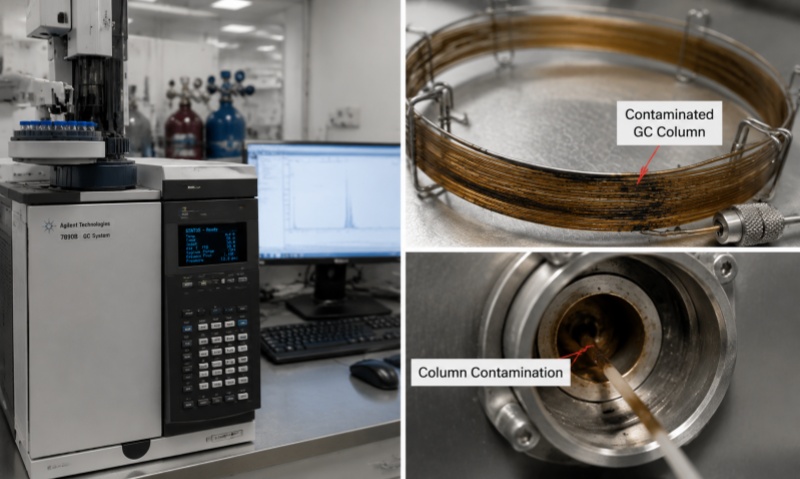
A decline in gas chromatography (GC) column performance is one of the most common issues encountered in analytical laboratories. It directly affects peak resolution, retention time stability, sensitivity, and overall data reproducibility. Understanding the root causes of column degradation is essential for maintaining reliable analytical results and extending column lifetime.
The most frequent cause of GC column deterioration is contamination from complex sample matrices. Non-volatile compounds, high-boiling residues, and matrix impurities gradually accumulate on the stationary phase or at the column inlet.
Typical symptoms include:
Increased baseline noise or drifting baseline
Peak tailing or broadening
Loss of sensitivity
Ghost peaks or carryover
Mechanism:
Contaminants slowly coat the stationary phase, reducing its active surface and altering partitioning behavior. In severe cases, inlet end contamination can permanently damage the first section of the column.
Prevention and solution:
Use proper sample cleanup techniques (SPE, filtration, derivatization)
Install a guard column or retention gap
Regularly trim 10–50 cm from the column inlet
Replace inlet liner frequently
Exceeding the maximum temperature limit of the GC column is a critical factor leading to irreversible degradation.
Symptoms:
Rapid loss of column efficiency
Baseline instability at high temperature
Decrease in retention time consistency
Mechanism:
High temperatures accelerate stationary phase bleeding and chemical breakdown of the bonded phase, leading to reduced film thickness and altered selectivity.
Prevention:
Always operate within manufacturer-specified temperature limits
Avoid prolonged isothermal runs near maximum temperature
Use temperature programming instead of high isothermal conditions
Oxygen is highly destructive to most GC stationary phases, especially at elevated temperatures.
Symptoms:
Sudden increase in column bleed (rising baseline in MS detectors)
Loss of peak shape and efficiency
Permanent reduction in column lifetime
Mechanism:
Oxygen reacts with the stationary phase, breaking siloxane bonds and causing irreversible phase damage.
Common sources of oxygen:
Leaky carrier gas lines
Poorly conditioned gas traps
Cylinder depletion or regulator failure
Prevention:
Ensure high-purity carrier gas (≥99.999%)
Install oxygen and moisture traps
Perform regular leak checks
Excessive sample injection volume or concentration leads to column overloading, which compromises chromatographic separation.
Symptoms:
Distorted peak shapes (fronting or tailing)
Loss of resolution between adjacent peaks
Nonlinear response
Mechanism:
When the stationary phase capacity is exceeded, analytes do not partition properly, resulting in saturation effects.
Prevention:
Reduce injection volume
Dilute samples appropriately
Use split injection mode when necessary
GC column performance is often mistakenly attributed to the column itself, while the actual issue originates in the injector system.
Common problems:
Dirty inlet liner
Septum bleeding
Incorrect inlet temperature
Poor split ratio control
Symptoms:
Ghost peaks
Poor reproducibility
Broad or distorted peaks
Solution:
Replace inlet consumables regularly
Optimize injector temperature
Ensure correct split/splitless settings
All GC columns have a finite lifespan. Over time, the stationary phase naturally degrades through thermal and chemical aging.
Symptoms:
Gradual loss of resolution
Increased baseline drift
Reduced efficiency (fewer theoretical plates)
Mechanism:
Continuous exposure to heat and analytes slowly breaks down the stationary phase, reducing film uniformity.
Solution:
Trim column inlet regularly
Replace column after performance decline becomes irreversible
Exposure to water, acids, or reactive compounds can damage sensitive stationary phases.
Symptoms:
Irreversible retention time shifts
Peak distortion for polar analytes
Reduced reproducibility
Prevention:
Use appropriate column chemistry for target analytes
Avoid introducing water unless using water-compatible columns
Properly dry carrier gas system
The performance degradation of a GC column is typically caused by a combination of contamination, thermal stress, oxygen exposure, overloading, inlet issues, and natural aging. In many cases, the column itself is not immediately damaged but suffers from upstream system problems such as poor inlet maintenance or gas purity issues.
Proper maintenance practices—including regular column trimming, inlet replacement, leak checking, and controlled operating conditions—can significantly extend column lifetime and maintain high analytical performance. Understanding these mechanisms allows laboratory personnel to diagnose problems accurately and prevent unnecessary column replacement costs.