
Consultation Hotline
+1 (302) 618-8777
+1 (302) 618-8777
Current location:Home > Blogs > Industry News
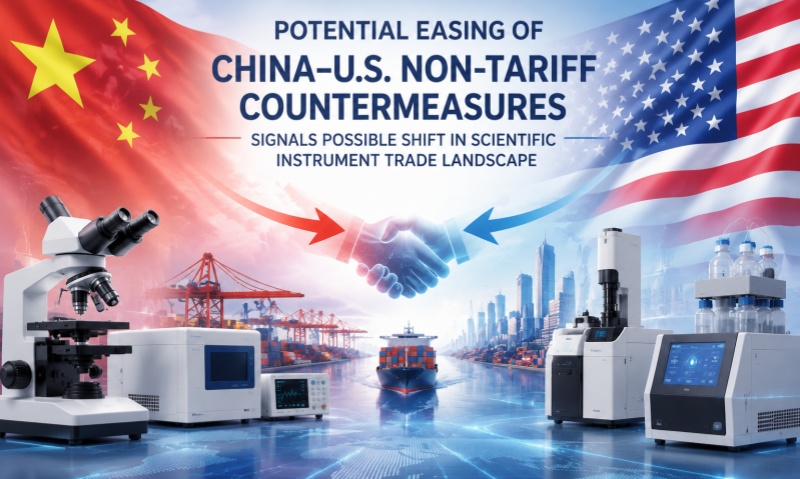
In a development that could mark a significant turning point in China–United States trade relations, recent policy signals suggest that China may suspend or roll back certain non-tariff countermeasures introduced since March 4, 2025. Among the most closely watched implications of this potential shift is the possible easing of restrictions on U.S. scientific and laboratory instrument companies previously affected by China’s “Unreliable Entity List” framework and related compliance measures.
While official confirmation and detailed implementation guidelines have not yet been fully published, early indications have already triggered widespread discussion across the global analytical instrumentation and life sciences industries. Analysts note that even incremental easing could reshape procurement flows, after-sales service access, and long-term strategic positioning for major multinational suppliers in China’s high-end laboratory market.
According to policy observers, the reported suspension or rollback of selected non-tariff retaliatory measures appears to be part of a broader recalibration of trade risk management rather than a full-scale reversal of regulatory frameworks.
Since 2025, China has gradually expanded its use of administrative trade tools—such as export controls, procurement restrictions, and the “Unreliable Entity List”—as a response mechanism to escalating geopolitical tensions and technology restrictions imposed by the United States.
However, the latest signal suggests a possible shift toward stabilization, particularly in sectors where supply chain continuity is critical, such as pharmaceuticals, biotechnology, environmental testing, and semiconductor research.
Laboratory instruments—including LC-MS, GC-MS, HPLC, ICP-MS systems, and associated consumables—are widely regarded as strategically sensitive but operationally indispensable technologies. As a result, any easing of restrictions could have immediate downstream effects on research institutions, CROs, and industrial laboratories across China.
The analytical instrument sector represents one of the most globally integrated high-technology industries. U.S. companies dominate key segments, particularly in mass spectrometry, chromatography, and life sciences instrumentation.
If restrictions tied to the Unreliable Entity List are eased or selectively lifted, several major multinational manufacturers could see improved access to:
Public research procurement channels
Pharmaceutical R&D contracts
Clinical laboratory partnerships
After-sales service and spare parts supply chains
Cross-border technical support operations
Industry analysts emphasize that even the perception of easing restrictions can significantly improve market sentiment, inventory planning, and capital investment cycles.
While no official “delisting” announcement has been confirmed, market participants are closely watching several major U.S.-based scientific instrumentation and life science companies that have historically faced varying degrees of regulatory or procurement uncertainty in China.
Below is a list of key companies that could potentially benefit from any relaxation of non-tariff countermeasures or entity-based restrictions:
Agilent is one of the most important suppliers of chromatography systems (HPLC, GC), mass spectrometry platforms, and laboratory software. China represents a major revenue market for Agilent, especially in pharmaceutical QC and environmental testing.
Waters is a global leader in liquid chromatography and high-resolution mass spectrometry. Its systems are widely used in drug development, food safety, and proteomics research in China.
Thermo Fisher has one of the most diversified portfolios, spanning analytical instruments, reagents, and laboratory consumables. It is deeply embedded in China’s biotech and clinical laboratory infrastructure.
Through its life sciences subsidiaries, Danaher is a major player in chromatography, diagnostics, and bioprocessing tools. Its scientific brands have strong penetration in Chinese pharmaceutical R&D.
SCIEX specializes in triple quadrupole and high-end mass spectrometry systems widely used in quantitative bioanalysis and clinical research. Its instruments are critical in regulated laboratories.
Formerly part of PerkinElmer, Revvity focuses on diagnostics, imaging systems, and analytical tools. It maintains strong presence in clinical and academic research markets.
Illumina dominates the next-generation sequencing (NGS) market. Although not traditionally a chromatography company, its genomics platforms are essential to China’s precision medicine ecosystem.
PerkinElmer (now partially reorganized under Revvity for life sciences operations) remains a key supplier of analytical and environmental testing instruments in China.
Unlike consumer technology markets, the laboratory instrumentation sector is highly dependent on long-term procurement cycles, validated methods, and regulatory compliance continuity. Even short-term policy uncertainty can delay:
Pharmaceutical validation projects
Hospital diagnostic upgrades
Environmental monitoring system procurement
University research infrastructure investments
For this reason, any easing of restrictions—formal or informal—tends to generate an immediate rebound in distributor confidence and purchasing forecasts.
Industry distributors in China report that procurement committees often adopt a “wait-and-see” posture during periods of geopolitical uncertainty, particularly for high-value systems exceeding $100,000 per unit.
A stabilization of U.S.–China trade frictions in this sector could therefore unlock significant pent-up demand.
China’s Unreliable Entity List (UEL) mechanism was designed as a countermeasure tool to address foreign entities deemed to have violated market principles or disrupted Chinese corporate interests. Inclusion on the list can lead to restrictions on:
Import/export activities
Investment approvals
Government procurement participation
Executive entry permits
Technology cooperation agreements
However, enforcement intensity has varied across industries and periods. In practice, many multinational scientific companies have continued operating in China through subsidiaries, distributors, and localized service networks, even under heightened scrutiny.
A partial rollback or suspension of related measures would likely focus on restoring predictability rather than removing all regulatory oversight.
Executives in the analytical instrumentation sector are reportedly adopting a cautiously optimistic stance. While no one expects an immediate return to pre-trade-tension conditions, even incremental improvements in regulatory clarity are seen as meaningful.
Key expectations include:
Faster customs clearance for high-end instruments
Improved spare parts logistics
Resumption of in-person technical training
Expanded joint venture research collaborations
Greater confidence in long-term capital expenditure planning
A senior distributor in East China noted that “predictability matters more than policy direction. If policies stabilize, investment will follow quickly.”
Beyond individual companies, the potential easing of non-tariff countermeasures reflects a broader recalibration in global scientific supply chains. Over the past several years, laboratories worldwide have faced pressure from:
Semiconductor export restrictions
Dual-use technology classification tightening
Localization requirements in China
Diversification of procurement away from single-source dependence
A partial easing could temporarily slow the decoupling trend in scientific instrumentation while reinforcing China’s continued reliance on high-end imported analytical technologies.
At the same time, domestic Chinese instrument manufacturers are expected to continue advancing in parallel, particularly in mid-range analytical systems, potentially leading to a more segmented competitive landscape.
Despite the positive signals, analysts emphasize that the situation should not be interpreted as a full liberalization of trade policy. Instead, it may represent a calibrated adjustment designed to reduce friction in strategically important but non-sensitive sectors such as scientific research and healthcare.
The coming months will be critical in determining whether:
Administrative restrictions are formally revised
The Unreliable Entity List is modified or selectively applied
U.S. companies regain stable procurement access
Or whether current signals remain largely symbolic
For now, the global laboratory instrumentation industry is watching closely. Even small regulatory shifts between the world’s two largest economies can translate into billions of dollars in redirected equipment sales, service contracts, and research infrastructure investments.
What remains clear is that scientific instrumentation—despite its technical nature—has become an increasingly strategic component of global economic diplomacy.